
White Paper: AI in the Digital Funnel
Posted
June 15, 2026
Renters have moved their search into AI assistants, and the funnel now rewards reputation, speed, and managed channels. The operators who built those assets are pulling away.
This paper draws on first-half 2026 data from Virtú's portfolio, operated by North Coast, to show what an AI-driven leasing funnel looks like in practice after four years of refinement, and what it is contributing to leasing volume, cost and rent growth.
What you'll learn
- Why managed channels like property websites produced 83% of signed leases from under half the leads
- How an AI leasing agent books 81% of tours with no human involved, and why response speed matters
- How many additional leases AI is plausibly adding each year, and how we estimate it
- What AI in collections and maintenance has to do with reputation, and why reputation drives the funnel
- The real return on AI spend, and the limits of vendor-reported ROI
AI has moved into the daily work of running apartments
It answers leasing questions at midnight, follows up on late rent, and routes maintenance work orders. Renters are changing, too. A growing share of them now begin their home searches with an AI assistant rather than a standard Google search.
Well-run, connected AI systems, paired with the enthusiastic resident sentiment that service-oriented teams produce, are becoming an outsized advantage. We expect this advantage to compound as AI turns reputation and lead orchestration into more qualified demand at lower cost.
While the size of AI's role is still being measured, comparative portfolio data, particularly from the first half of 2026, points to these systems contributing meaningfully to revenue outperformance. The foundation reflects various inputs and years of integration across property operations, presenting an advantage that would be hard for others to replicate.
Based on current estimates that we will detail further, North Coast's AI leasing and voice capabilities are plausibly on track to add between 300 and 600 signed leases a year against a base of roughly 2,000.
The advantage is already showing up on price. RealPage benchmark data shows our same-store properties grew executed lease rates 4.3 percent in the first half against 3.1 percent for comparison sets, a 120-basis-point premium on signed leases, net of concessions. The rest of this paper traces how our AI-orchestrated funnel contributes to the gap.
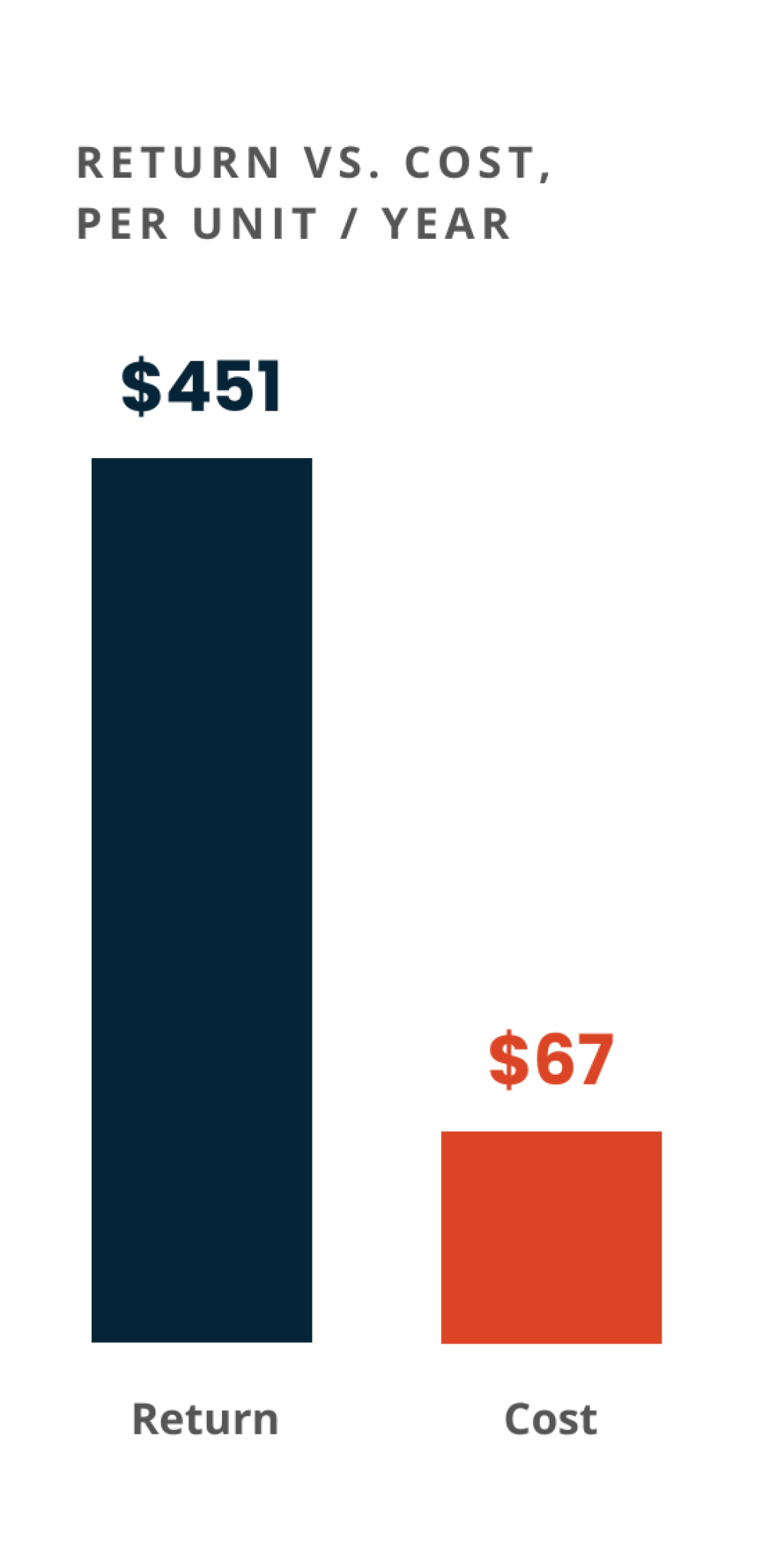
- $451 estimated annual AI return per unit, against a spend of about $67 per unit (EliseAI)
- 120bps premium on signed leases, net of concessions
- 81% of Q2 2026 tours booked by AI with no human agent
- 8x managed channels like property websites convert leads eight times better than third-party listings
One acquisition loop, four years in the making
North Coast was an early adopter of AI-assisted digital spend and leasing. Our AI leasing agent has been learning in our environment since 2022, so the loop is well established: high-intent renters enter the funnel through text, chat, email, and voice, the AI agent answers questions and books the tour, and those interactions become training signals that point the next round of managed media spend at renters who behave the same way.
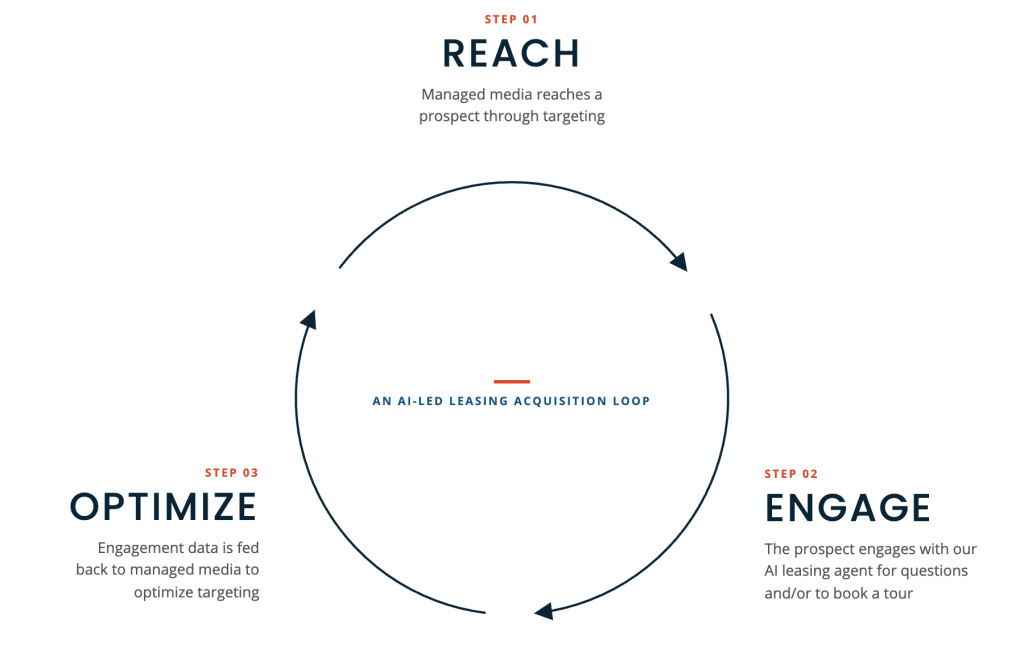
The result: our managed spend continues to gain efficiency. Over the past year, Google Ads conversions grew 48 percent on 9 percent more spend, with cost per conversion down 26 percent. In the second quarter alone, year over year conversions rose over 20 percent on 3 percent more spend.
Rental searches are moving to AI assistants
- 38x: over the past year, ChatGPT referrals to our websites grew from 24 sessions to 919, a 38x increase
- 73%: those visitors behave like qualified prospects, with a 73 percent engagement rate for booked tours attributed directly to an AI referral
- 2x: our resident newsletters are now published as indexable pages, with views more than doubling in the quarter, driven by the same LLMs
128%: every North Coast community carries an AI-optimized answers page built to address the questions renters actually ask, and these pages draw increasing traffic from LLMs. Answers page views grew 128 percent year over year in the quarter, roughly eight times the pace of overall site traffic.
AI books four out of five of our tours
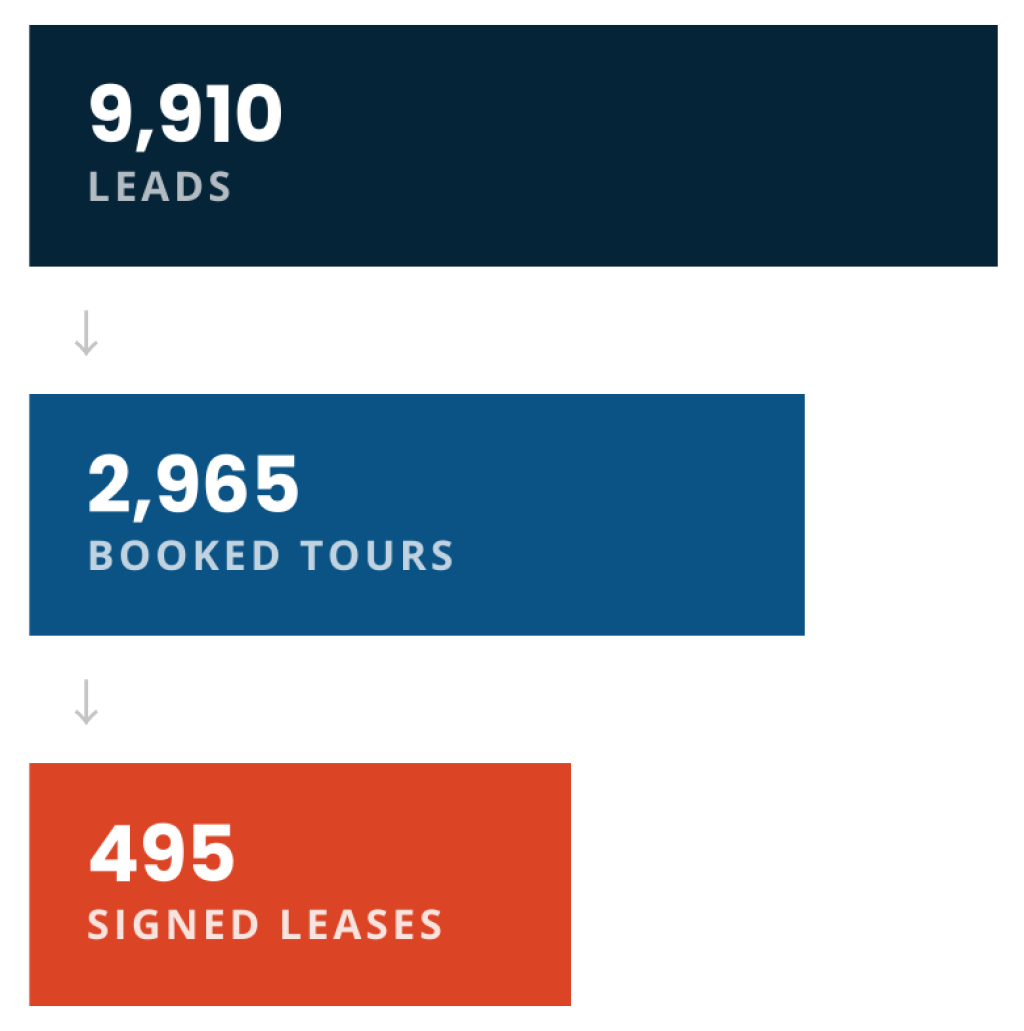
In Q2 2026, our AI leasing agent turned 9,910 leads into 2,965 booked tours and 495 signed leases, booking 81 percent of those tours with no human agent involved.
Speed is a key reason why the top of the funnel holds. Median first response was 37 seconds, day or night, and nearly half of all leads arrive outside office hours, when no leasing team is available.
The newest piece we are actively building on is VoiceAI, which answers inbound phone calls automatically and will be critical to continued efficiency gains. It went live across the portfolio in April and answered all 2,392 calls in the quarter, adding 971 new phone leads to the funnel that the office would otherwise have missed.
Where the leases actually come from
Not all channels produce leases equally, and Q2 2026 data indicates that the gap is wide.
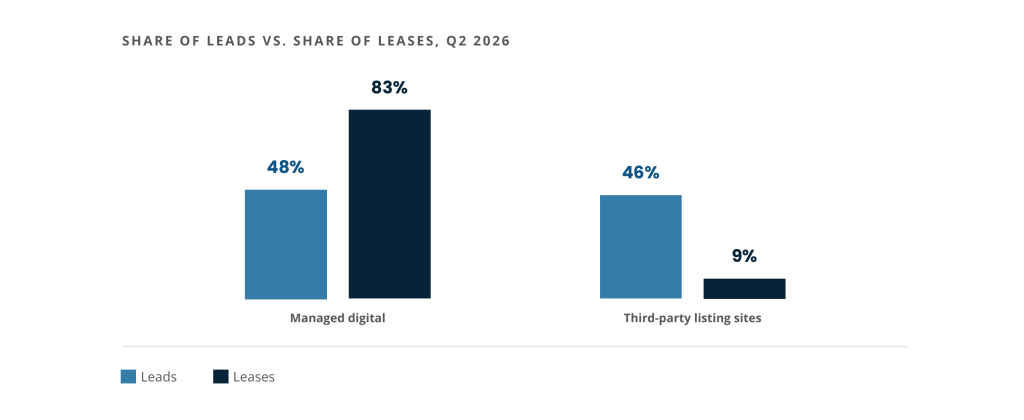
Our managed digital stack (community websites, PPC, paid and organic social, and business profiles) produced 83 percent of the quarter's signed leases from just 48 percent of lead volume. Third-party listing sites produced 46 percent of leads and 9 percent of leases.
Property websites delivered 62 percent of all signed leases, at an 11.2 percent lead-to-lease rate, roughly twice the portfolio average.
Actively managed Google Ads leads booked tours at 72 percent, the highest-intent paid source we run.
At the other end, one high-volume listing source converted at roughly 1 percent, a cost the system would identify and manage out.
Media that feeds our managed channels
Our Google managed media tools, including Performance Max, are driving a lot of this momentum.
A single-property pilot at our Bellevue, WA asset, The Margot, produced 72 confirmed tours before the program scaled. This year, Performance Max went portfolio-wide, with 19 North Coast communities live on April 1 and 23 communities live by quarter-end, producing 253 conversions in its first full quarter. Meta's Q2 2026 data shows the same pattern, rebuilt around booked tours and producing 293 attributed tours in the quarter, up 24 percent vs. Q1.
As our AI bidding optimizes against confirmed tour signals, that sharper targeting does not just lower cost. It routes higher-intent renters back to property websites we control, where the ecosystem does its real work.
Total site traffic reached a record 972,167 page views in the quarter, up 15.6 percent year over year, while sessions held flat, meaning each visit went further.
YouTube Shorts remain the portfolio's discovery engine, with 3.5 million views in the quarter across 22 property channels. AI-generated video now powers many property Shorts at a fraction of traditional production cost, and one property film has passed 610,000 views on its own.
- 253 Performance Max conversions in its first full quarter, portfolio-wide
- 293 Meta attributed tours in the quarter, rebuilt around booked tours, up 24%
- 3.5M YouTube Shorts views in the quarter across 22 property channels
The true cost of an attended tour
Tours for two communities with similar ad economics can be dramatically different in cost, because even within our portfolio, one property converts 38 of 45 booked tours into attended tours and another just 2 of 26.
That makes attendance the cheapest growth we have. The communities where we introduced or optimized virtual touring and scheduling this year now rank among the most efficient in the portfolio, which tells us what's achievable.
A second-half program aimed at the portfolio laggards targets attendance directly. Every five-point gain in attendance is worth roughly 150 additional attended tours a quarter, at no additional media cost.

Capturing leases that would have been lost
At a basic level, the question is whether the AI generates leases we would not have signed otherwise. We cannot answer that cleanly, because there is no version of the portfolio running without the AI to compare against.
The piece we are most sure of is voice. VoiceAI captured 971 new leads by phone in the second quarter, calls the office used to miss. Those are not leads we did a better job of converting. They did not exist in the funnel before. At the portfolio lead-to-lease rate, they translate to roughly 25 to 50 additional signed leases in the quarter, on the order of 100 to 200 a year.
Then add speed. Nearly half of all leads arrive when no leasing team is working, and the AI answers them in 37 seconds instead of the next morning. Speed to first response is one of the best-documented drivers of whether a lead converts at all. If an instant answer lifts conversion on those after-hours leads by even a point or two, that is another 50 to 100 leases a quarter.
The measure has a fair challenge. Some of those renters would have leased anyway, the next day or through another channel, so calling every lease incremental overstates it. The voice and after-hours effects also overlap. We think this is roughly offset by the managed digital and tour booking gains we do not count at all.
We estimate AI is plausibly on track to add somewhere between 300 and 600 signed leases a year against a base of roughly 2,000, with the VoiceAI capture alone a confident 100 to 200. A rough estimate for sure, but the direction is clear.
AI is plausibly on track to add somewhere between 300 and 600 signed leases a year against a base of roughly 2,000
Protecting the reputation that fuels the funnel
Everything above runs on reputation. Managed channels convert because renters trust what they read about us, and AI assistants recommend us because public sentiment tells them to. That sentiment is formed after move-in, which is why two results from outside the funnel are still relevant to the overall machinery.
AI in rent collections
$6.3M collected in H1 2026 without staff involvement
The same platform that books our tours now runs collections. Automated rent reminders and payment follow-up collected $6.3 million in the first half of 2026 without staff involvement and lifted our collection rate 65 basis points. Rent collection strains the relationship between staff and residents, and a consistent automated process handles it with less friction than a person making an uncomfortable call. Fewer strained conversations become fewer bad reviews.
AI in maintenance
16.8h → 3.8h median work-order resolution, roughly 4x faster
Maintenance is the larger reputation lever. Our AI-enabled inspection and dispatch platform cut median work-order resolution from 16.8 hours to 3.8 hours, roughly a quarter of the time, and 31 percent of eligible service calls were de-escalated before becoming emergencies. A problem resolved in four hours rarely leads to a negative review, and the 2026 ORA model weights pest, safety, and cleanliness complaints most heavily.
The return on $5.60 per unit per month
EliseAI estimates the annual return of the leasing and collections automation at $451 per unit per year, against a fully bundled cost of about $67 per year. We are instinctively skeptical of ROI calculated by the vendor selling the product, so we anchor on what we can observe directly.
From January to June 2026, AI collected $6.3 million without staff involvement and our collection rate improved 65 basis points. Over the past year, our AI leasing agent signed 1,674 leases. Roughly 15 hours per community per week went back to our teams.
The phone leads captured by VoiceAI in the last quarter are upside on top of that estimate. Even at a steep discount to the vendor's math, the return on a $5.60 per unit per month cost is one of the better capital allocations available to us.
The results at a glance
- Leasing: 9,910 leads to 495 signed leases; 81% of tours booked by AI with no human agent
- Managed channels: 83% of leases from 48% of leads; managed media conversion is ~8x third-party volume
- AI search: answers pages up 128% YoY, roughly eight times the pace of site traffic
- Paid media: Google Ads conversions up 20% on 3% more spend; Performance Max now portfolio-wide
- Pricing: same-store rent growth 4.3% vs 3.1% for comp sets, a 120 bps premium net of concessions
- After the lease: $6.3M collected autonomously; work-order resolution cut 16.8h → 3.8h
- Economics: estimated return of $451 per unit per year against a cost of about $67
What drove the results
We automated high-volume routine work first.
Leasing communication, rent reminders, and inspection triage came first because the work is repetitive, the rules are clear, and the volume makes automation worth the effort. Decisions that need judgment stayed with people.
The conversion signal mattered more than the software.
The largest single improvement in our paid media program came from changing what the bidding optimizes against, from form fills to confirmed tour bookings, rather than from any new platform. The systems improved quickly once they were pointed at real behavior.
Reputation and content are years in the making.
The assistants build their answers from reviews and structured local content, and our standing there reflects years of investment in both. That standing is what the quarter's managed-channel results rest on.
Vertical integration turns a win into a portfolio-wide one.
Because Virtú owns North Coast, a change that works at one property reaches all of them. We keep the full benefit rather than splitting it with a third-party manager, and the operating data becomes an input to how we underwrite.
Three limits on these results
- Vendor-measured ROI is directional. We treat platform-reported returns as an upper bound and manage to the numbers we can verify.
- AI will not fix a service problem. Automation makes the underlying operation more visible, and the results in this paper sit on top of teams that were already performing.
- Autonomy still requires owners. Every automated workflow at North Coast has a named human accountable for its output, because these systems drift without regular intervention.

Carrying the advantage into the second half
We are pressing the same advantages into the back half of the year. The clearest near-term gain is attendance, converting more of the tours we already pay for toward the pattern set by our most efficient communities. We are deepening the content that earns AI-assistant visibility across every property. And we are extending the leasing automation further into onboarding, so the agent does more of the work from first contact to signed lease.
The results in this paper did not require anything exotic. We put the systems on routine work, kept people on the judgment calls, and measured the outcomes honestly. The tools will keep improving, driven by reputation and the integrated structure that lets us deploy them everywhere at once. We expect the results to keep widening across the portfolio.
Sources & methodology
- Virtú Investments. Operational AI for Multifamily: Inside the Virtú + North Coast Model. November 2025.
- Virtú Investments. The ORA Edge in Multifamily Investing. July 2026.
- RealPage Benchmark Data. July 2026.
- EliseAI. ROI methodology: fully bundled $5.60 per unit per month cost, annualized, assuming a $20 per hour leasing wage, 40 hours per week per FTE, and $20 cost per lead.
- Q2 2026 Digital Funnel Report. EliseAI platform exports (official, deduplicated), Google Ads, and Google Analytics GA4. Q2 2026, April 1 to June 30.
- Q1 2026 Digital Funnel Report. Google Ads, Google Analytics GA4, and EliseAI platform data. Q1 2026 vs. Q1 2025.
- EliseAI Performance Review, January through June 2026.
- Virtú | North Coast. Operating Overview and Principles.
- HappyCo, June 2026.