
White Paper: LLMs and the Growing Reputational Divide in Multifamily
Posted
July 1, 2026
Renters now choose homes through AI models trained on public sentiment. Managing to reviews is how an operator proves value, and the separation between winning and losing in this new competitive reality is widening.
Overview
Virtú treats online reputation as a continuous, third-party read on operations, scored by the people who experience a property every day, and has used it as an operating KPI and an underwriting input since before it became industry convention.
Now that LLM-based search is being adopted, renters increasingly choose a home through AI assistants, and with models built on public sentiment, the reviews residents write have become the inputs that determine which communities get surfaced.
There is nowhere to hide an operating problem from a model that reads everything, and we expect the separation between winners and losers to widen. This paper explains the shift, and how our vertically integrated operations team, North Coast, is positioned for it.
Public sentiment now feeds the models
Reviews were already a precondition to effective leasing: 81 percent of renters consider them essential when choosing a home, more than half will not rent a property rated below four stars, and review quantity and sentiment influence local search rankings, so reputation has long determined whether a prospect chooses a community.
What is new is the nature of the onramp. A majority of prospective renters now use AI tools to summarize a property's operational strengths and weaknesses from its reviews, and the shift is visible in our own funnel, with AI-assistant referrals to North Coast property websites up 38x year over year.
- 81% of renters consider reviews essential when choosing a home
- 38x YoY growth in AI-assistant referrals to North Coast websites
A human prospect skims a handful of reviews. A model reads all of them, weighs the pattern, and carries the conclusion into every answer it gives.
The implication is that managing to reviews is no longer a marketing discipline but the means by which an operator proves value. In the past marketing spend could always help paper over a service problem for a human audience. It cannot for a model that reads everything.
We built the practice for residents, not for LLM search, but the models keep rewarding the same underlying work.

What changed in 2026
J Turner's ORA (Online Reputation Assessment) aggregates ratings and reviews from more than 20 review sites and listing services into a single 0–100 score, updated monthly across roughly 150,000 properties nationwide, letting an investor compare communities on the one dimension financial statements have difficulty capturing. Two changes this year made the score more reliable, and both move the measurement layer in the same direction as the models.
01. ORA now reads the reviews, not just the stars
Beginning in early 2026, J Turner incorporated review content using its Thought Analysis text engine, weighting most heavily the categories that correlate with renter behavior: what it calls Apex Threats: pest problems, safety concerns, and cleanliness failures. A property can no longer offset an unresolved maintenance problem with solicited five-star move-in reviews, because the content of what residents write now moves the score.
02. Apartments.com removed the CoStar building rating
On April 22, 2026, Apartments.com removed the CoStar building-quality rating from its displayed scores. Blended with reviews at a weight equal to roughly 50 of them, it let a new luxury property open at 4.5 stars before a single resident had lived there. When it was removed, the national average fell across more than 65,000 properties, and J Turner updated ORA accordingly, effective May 2026.
4.18 → 3.43: national average displayed rating, before and after the pre-assigned building score was removed.
Both changes push scores to reflect operations more and marketing less, which amplifies the separation described above. We view that as favorable for our portfolio, with the caveat that scoring changes also move scores for reasons unrelated to operations, a limit we return to below.
Reputation's financial impact
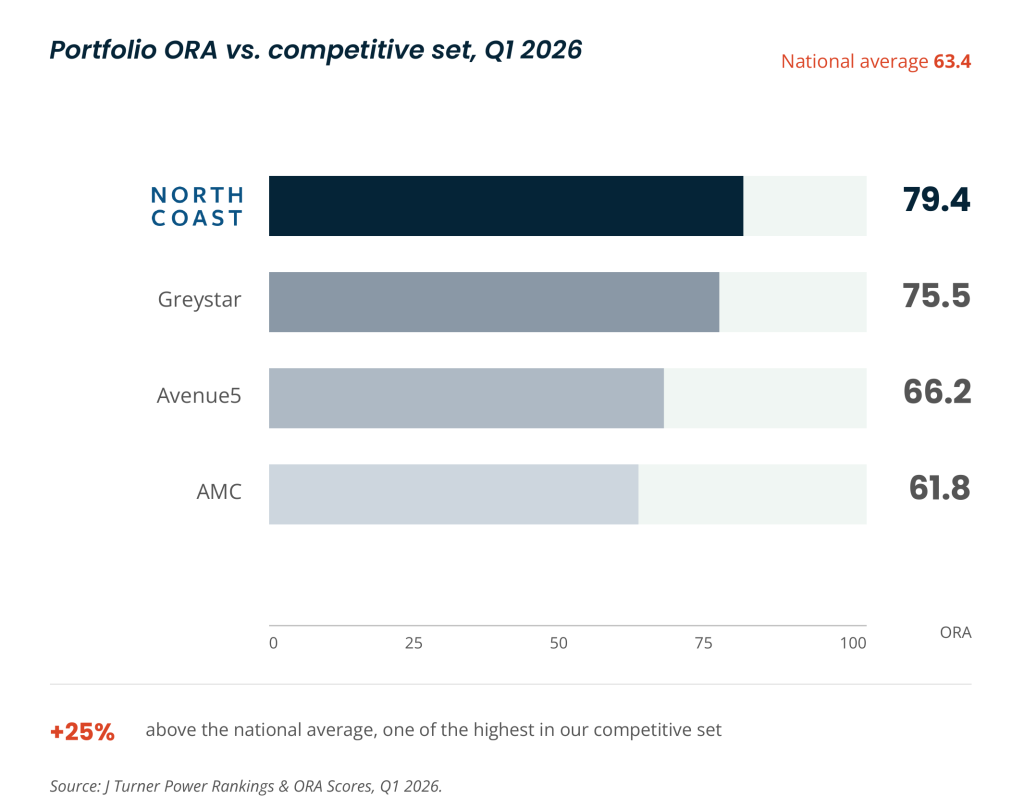
Research from RealPage and J Turner finds that each one-point increase in ORA is associated with a 9.3 basis-point premium in market-rent performance. Our portfolio is consistent with that evidence. As of Q1 2026, North Coast's portfolio ORA of 79.4 runs 25 percent above the national average of 63.4, and is one of the highest in our competitive set.
Two communities earned J Turner's Elite 1% Power Ranking. One of them, The Lark in San Mateo, was rated the top-performing property in the San Francisco market. In the first half of 2026, executed lease rates across our same-store portfolio grew 4.3 percent against 3.1 percent for comparable properties in our submarkets, a 120 basis point premium net of concessions (RealPage performance analytics).
Rent performance: ORA and market rent, 2026
- 9.3bps rent premium associated with each one-point increase in ORA
- 4.3% same-store executed lease rate growth vs. 3.1% for submarket comps, first half 2026
A high ORA does not drive rent growth on its own, but it is our most reliable proxy for value. We anchor on it and let the score stand as our source of truth for how the team's efforts are translating into great experiences for our residents.
Paid-media performance: Q1 2026 year over year
- +48% Google Ads conversions, on 9% more spend
- +52% conversion rate
- −26% cost per conversion
Two forces work together. The feedback loop in our paid media trains the spend toward the next high-intent renter with each confirmed booking. LLM referrals deliver prospects for whom much of the comparative thinking has already been done. The model has read the reviews and weighed the alternatives, so these leads arrive closer to a decision.

How North Coast operationalizes reputation
North Coast operates roughly 4,800 units across the western United States. Five disciplines form the basis for our reputational strategy.
01. Online reputation as the primary KPI
ORA is reviewed in the same meetings as occupancy and rent growth, at the same cadence and with even greater accountability given its foundational importance.
02. Hiring for service, and keeping the people we hire
Industry on-site turnover averages 33 percent a year. North Coast runs 22 percent, supported by a Partner Program whose tenure benefits include a property-sale bonus of up to a full year of salary. Our 2025 employee survey came back at 98 percent job satisfaction.
03. Creating goodwill with residents and neighbors
Our impact program has run continuously since 2010. In 2025 the portfolio produced more than 800,000 kWh of solar energy, reached 30 percent EV-charger penetration, and donated nearly 70,000 pounds of food to surrounding neighborhoods, signaling a value system residents and team members recognize as genuine.
04. AI where it helps, people where they matter
Our AI leasing agent has been learning in our environment since 2022. Over the trailing year it engaged nearly 27,000 leads (roughly 13,700 after hours) and converted 1,674 into signed leases. AI collections recovered $6.3 million autonomously in the first half of 2026 and lifted our collection rate 65 basis points, returning roughly 15 hours per community per week to our teams.
05. A named owner in every region
Regional Senior Business Managers own reputation training, response protocols, and early detection, exactly what the new model's Apex-Threat weighting rewards. AI-assisted dispatch has cut median work-order resolution from 16.8 hours to 3.8, and problems resolved quickly rarely surface as reviews.
ORA as an underwriting input
A management problem priced as a real estate problem, and the review history tells us where the failures are.
A property with a weak reputation is frequently a management problem priced as a real estate problem. Using sentiment data, we are more likely to know the cost and timeline to fix it, and the review history tells us where the failures are often before we ever tour the asset.
Historically the constraint was not only finding mismanagement but proving the turnaround, since an improved operation could take years to be recognized, one referral and one lease at a time. That has changed. The scores update monthly and the models broadcast the improvement as fast as residents write it, so recognition shows up in visibility, then leasing velocity, and ultimately in what the next buyer will pay.
The inverse screen is just as useful: a property already scoring near the top of its market has little reputation upside left, and we underwrite accordingly.

What ORA is not
It is one input, not a complete thesis
ORA sits alongside submarket supply, basis, rent rolls, and physical condition. It is critical to our thinking, but success requires getting the other inputs right as well.
It lags at small properties
A community with few reviews can see its score swing on a handful of data points, so we weight the signal by review volume.
It can be temporarily managed, though less than before
Aggressive review solicitation could influence the old model. The 2026 content-based model narrows the gap but cannot smooth over chronic issues. Over a hold period, operations win.
Platform changes move scores for non-operating reasons
The April 2026 Apartments.com change shifted scores across the industry overnight. Comparing scores across model vintages without adjustment is prone to producing misleading results.
Conclusion
There is nowhere to hide an operating problem from a system that reads everything. Public sentiment now drives the inputs to the models renters use to find a home.
We expect the separation between well-run and poorly run communities to keep widening, in visibility first, and in rents and values behind it.
Sources
- Reputation.com. New Property Management Report from Reputation Reveals that Online Feedback Significantly Impacts Renter Decision-Making.
- Google Support. How to improve your local ranking on Google.
- J Turner Research. Insights from Turner: These 3 Things Will Tank Your ORA Score. (2025)
- Virtú | North Coast. Operating Overview & Principles, Q2 2026. Portfolio ORA and competitive set per J Turner Power Rankings & ORA Scores, Q1 2026; AI performance per EliseAI and HappyCo reviews, January to June 2026; paid-media per Q1 2026 Digital Funnel Report.
- J Turner Research. ORA FAQs.
- J Turner Research. ORA Score methodology and 22 operational categories; 2026 ORA model announcement.
- J Turner Research. Apartments.com Ratings Have Changed: What It Means for ORA and Your Communities. (May 2026)
- J Turner Research / RealPage. The Only Comprehensive Reputation Score | ORA.
This document contains preliminary, limited information regarding Virtú Investments and is subject to change. It is not an offer to sell or the solicitation of an offer to purchase any security, investment product or advisory service. Any such offer or solicitation may only be made by means of a current Private Placement Memorandum provided by Virtú Investments, LLC. Descriptions of prior performance in this document should not be regarded as representations of future performance by the Fund. Past performance is not indicative of future Fund performance. Certain of the statements in this document consist of, or contain, forward-looking statements. Those statements include references to the Fund's investment objectives, targeted return, targeted cash flow, investment strategy, anticipated or estimated performance and risk management, as well as statements containing words such as expects or expected, projected, estimated, believe or belief. Forward-looking statements are inherently speculative and should not be relied upon in making an investment. There can be no assurance that the results reflected in any such anticipated or estimated summaries of performance, targeted returns or targeted cash flows will be realized by the Fund. Actual Fund results will vary from the estimates of performance and targets contained herein, and those variations may be material. Furthermore, the Fund may not be able to achieve its investment objectives due to various risks. This document is not intended to provide legal, business or financial advice. Please consult your applicable professional for such advice.